English
  français
  Deutsch
  Español
  italiano
  português
  tiếng việt
  Türkçe
  slovenský
  slovenčina
  беларускі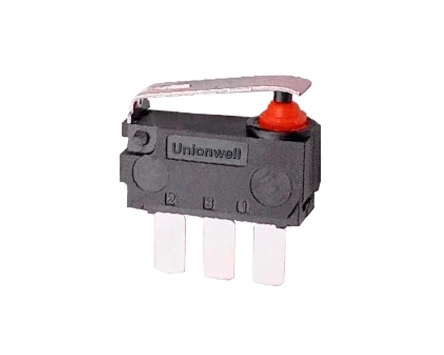
Global_Safety_Approvals_Basic_Micro_Switch_G5.webp "Global Safety Approvals Basic Micro Switch G5")


RM1311, Renfeng Building, No. 490, Tianhe Road, Tianhe District, Guangzhou, Guangdong, China, 510630.
Factory Address:No. 9 Park Avenue, Longmen County, Huizhou City, Guangdong Province, China

Rice cookers are a staple in modern kitchens, evolving from simple mechanical units to today's intelligent, multi-functional models. While their designs and features have advanced, two priorities remain unchanged: safety and precise control.
A small yet critical component—the micro switch—plays a vital role in ensuring safe operation and enabling intelligent functions.
A micro switch is a precision device that uses mechanical contacts to achieve rapid on-off switching. It is characterized by high sensitivity, long service life, and excellent reliability. In rice cookers, its primary functions include:
Detecting the inner pot's placement
If the heating plate is powered without the inner pot in place, it can cause dry heating, damage the heating element, and pose safety risks. The micro switch detects whether the inner pot is present, allowing heating to start only when it is correctly positioned.
Detecting lid closure
Smart rice cookers often have modes such as “keep warm,” “quick cook,” and “pressure cooking.” Many of these functions depend on the lid being properly closed. The micro switch relays the lid’s status to the control system, enabling coordinated control of heating and warming functions.
Though these tasks seem simple, they directly affect both safety and cooking performance.
In rice cookers, micro switches are generally installed in two positions:
1. Inner pot detection switch
Location: Beneath the heating plate or in the inner pot holder.
Principle: The weight or a protrusion on the inner pot depresses the actuator lever, engaging the internal spring plate to close the contacts.
Function: When the pot is removed, the contacts open, cutting off the heating circuit.
2. Lid detection switch
Location: In the hinge or latch mechanism.
Principle: Closing the lid mechanically presses the switch, sending a closure signal.
Function: Prevents heating when the lid is open, or automatically switches to warming mode.
In circuit design, the micro switch usually connects to the main control board and carries only small currents as a signal input. However, the cooker's internal environment is hot, humid, and exposed to cooking vapors—conditions that demand strong protection.
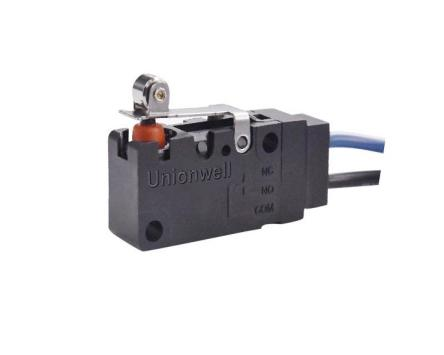
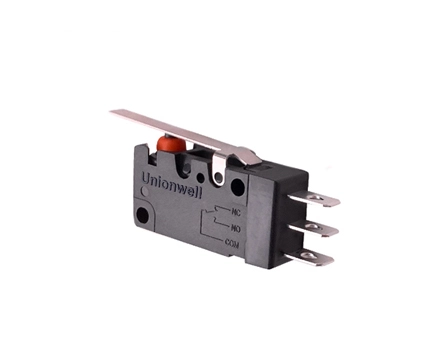
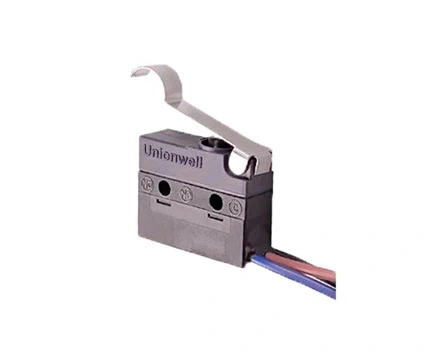
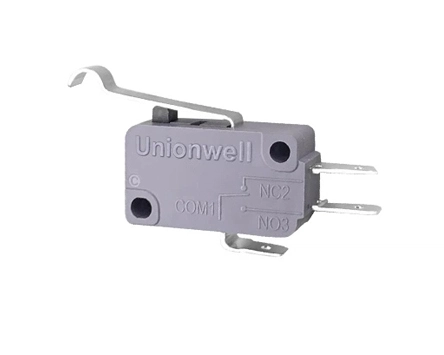
This is why many manufacturers choose sealed micro switches—such as the Unionwell G905—to handle the kitchen’s challenging conditions.
To ensure long-term stability in rice cooker applications, design engineers should consider:
Ingress protection rating
Cooking generates steam and condensation. Inadequate sealing can lead to oxidation, short circuits, or failure. An IP67-rated sealed micro switch offers dust-tight sealing and protection against water ingress.
Sensitivity and durability
Since pot placement and lid closure involve light mechanical action, the switch should require low actuation force and respond quickly. With frequent daily use, a mechanical life of over 500,000 cycles is ideal.
Heat resistance
Temperatures near the heating zone can exceed 100 °C. High-temperature materials and designs are necessary to maintain performance.
Mounting configuration
Depending on the cooker's structure, a lever-type, plunger-type, or short-travel design may be required. Customization capability is a valuable advantage from a supplier.
For a rice cooker with automatic keep-warm:
Insert inner pot → Pot triggers the inner pot detection micro switch → Control board closes the heating circuit.
Cooking → Control board adjusts heating based on temperature sensors and timing.
Lid detection → Lid switch remains engaged, ensuring stable pressure and temperature.
Cooking ends → Control board cuts heating, switches to keep-warm mode (based on lid closure signal).
Remove pot → Inner pot switch opens, fully cutting power to prevent dry heating.
This combination of micro switch + sensors + control logic delivers both safety and convenience.
Though small, a failed micro switch can cause major problems:
Failure to detect inner pot → Cooker will not start heating.
Failure to detect lid closure → Pressure cooking mode becomes unavailable.
Poor contact → Unexpected shutdown during cooking.
Contact sticking → Heating without a pot in place, creating safety hazards.
This makes high-quality, long-life switches and precise installation critical.
Widely adopted in rice cooker production, the Unionwell G905 offers:
IP67 protection – Dust-tight and water-resistant, ideal for high-humidity kitchens.
Compact design – Fits into tight spaces within the appliance.
Long service life – Up to 500,000 mechanical cycles for lasting reliability.
Customization options – Adjustable actuation force, lever type, and other parameters to match different cooker models.
Global certifications – UL, ENEC, CE, and CQC approvals for compliance with international appliance standards.
In mass production, the G905 has consistently demonstrated stability and performance.
With the rise of smart homes, rice cookers are evolving toward multi-sensor integration, network connectivity, and personalized cooking programs. While some functions may rely on electronic sensors, micro switches will remain essential for core safety control thanks to their low cost, high reliability, and immunity to electrical interference.
Future rice cookers may integrate micro switches with pressure, temperature, and weight sensors to enable:
Automatic recognition of ingredient weight and type
Intelligent cooking progress detection
Adaptive heating curve adjustments
Enhanced safety protection
In such systems, high-performance components like the Unionwell G905 will remain indispensable.
A micro switch may be small, but it plays a vital role in a rice cooker's safety and control. From preventing dry heating to enabling automatic transitions between cooking and warming, it safeguards daily cooking while enhancing convenience.
Choosing the right micro switch not only boosts product reliability but also reduces after-sales issues and strengthens brand reputation. For appliance manufacturers, specifying high-protection, long-life, customizable components during the design phase is key to maintaining a competitive edge.
With its robust sealing, stable performance, and flexible customization, the Unionwell G905 sealed micro switch has become the preferred choice for many leading rice cooker brands.