 English
  français
  Deutsch
  Español
  italiano
  português
  tiếng việt
  Türkçe
  slovenský
  slovenčina
  беларускі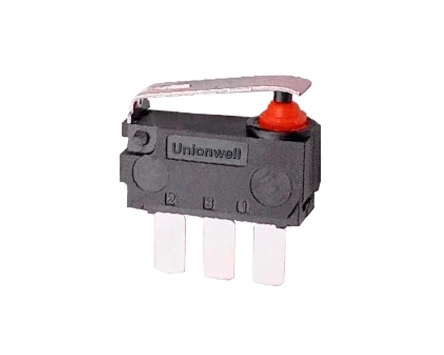
Global_Safety_Approvals_Basic_Micro_Switch_G5.webp "Global Safety Approvals Basic Micro Switch G5")



RM1311, Renfeng Building, No. 490, Tianhe Road, Tianhe District, Guangzhou, Guangdong, China, 510630.
Factory Address:No. 9 Park Avenue, Longmen County, Huizhou City, Guangdong Province, China

Engine idle speed is often called the "heartbeat" of a car while it waits. Whether you are stuck in traffic or waiting at a red light, the engine must maintain a stable speed—typically between 750 and 1050 RPM—without stalling or wasting fuel. This delicate balance is managed by the Idle Air Control Valve (IACV). But how does the Electronic Control Unit (ECU) know precisely when to adjust the airflow? The secret lies in a precision component: the micro switch.
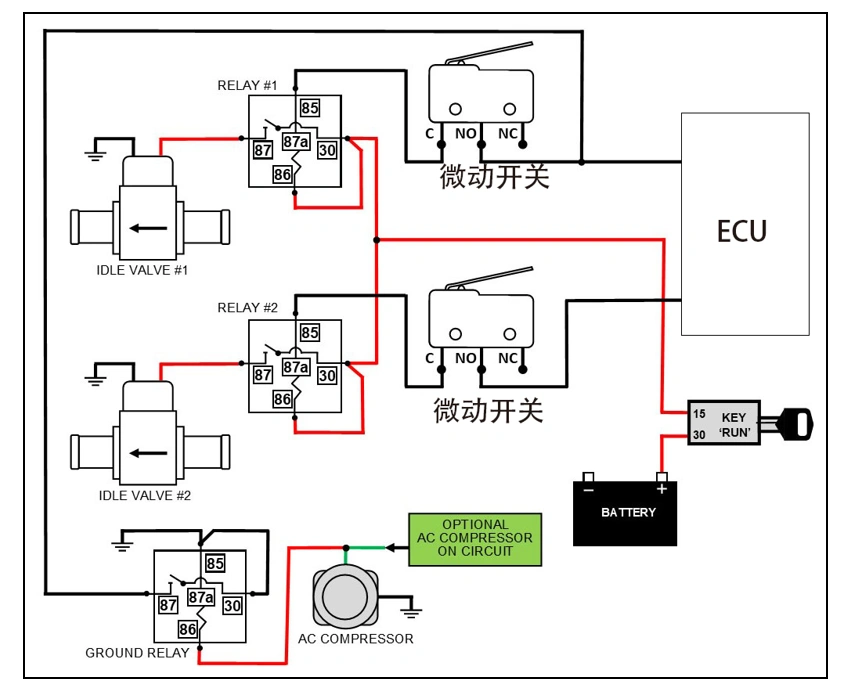
The IACV is an electromechanical device installed on the throttle body's bypass passage. Its primary function is to regulate the amount of air entering the engine when the throttle is closed.
Low RPM (<750): The valve opens to increase airflow and boost RPM to prevent stalling.
High RPM (>1050): The valve closes to reduce airflow and lower RPM to save fuel.
Load Compensation: Crucially, when accessories like the Air Conditioning (AC) compressor kick in, the engine load spikes. The IACV must instantly compensate to maintain stability.
In this control loop, microswitches act as the critical sensor for signal transmission and control logic.
How It Works:
Load Detection: When engine idle load increases (e.g., turning on the AC), a relay triggers the micro switch.
Signal Transmission: The micro switch sends an immediate signal to the ECU (Engine Control Unit).
ECU Action: Upon receiving this signal, the ECU commands the idle control valve to increase the intake air volume.
Result: The idle speed rises to match the load, preventing engine vibration or stalling. Conversely, when the load drops, the switch releases, prompting the ECU to reduce airflow and conserve fuel.
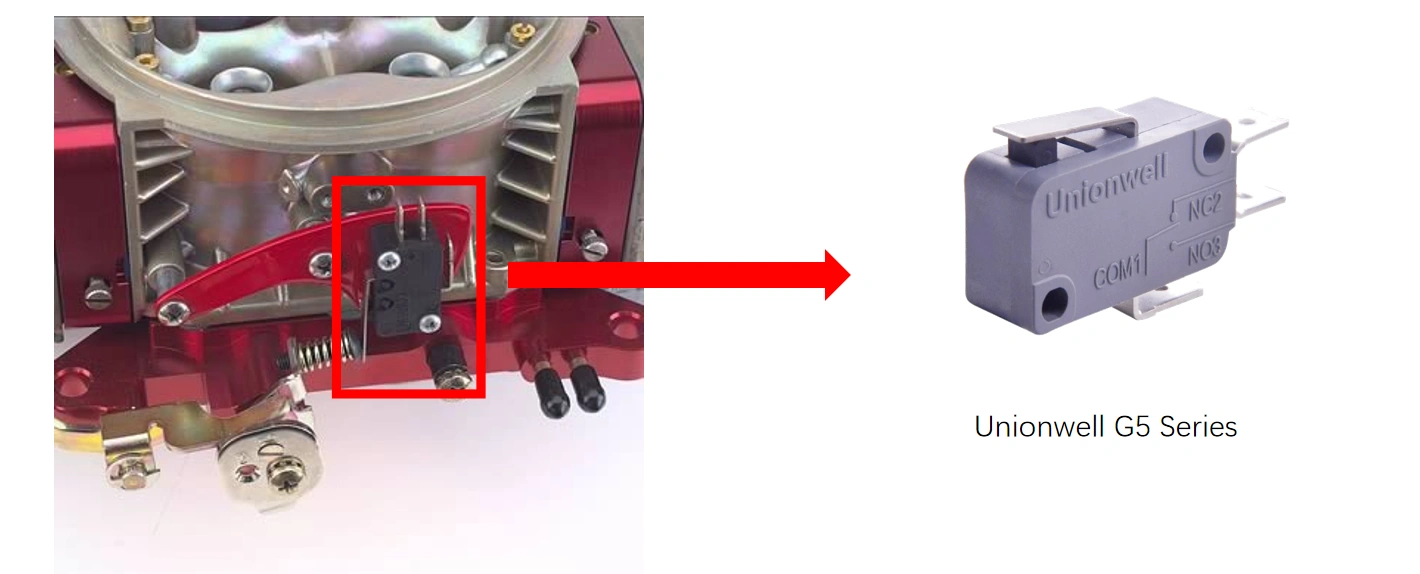
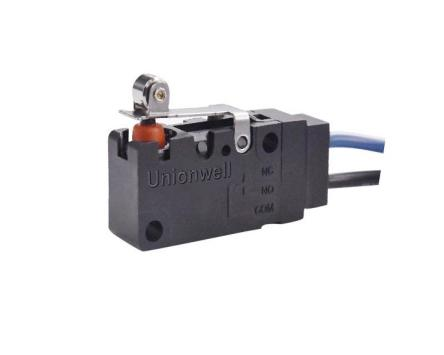
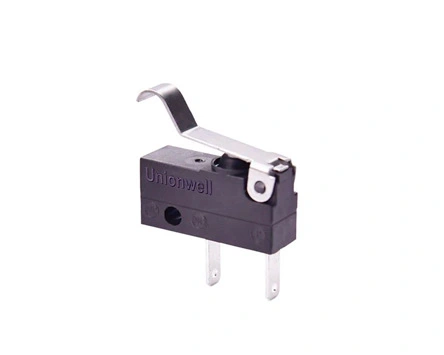
For such a high-frequency, precision application, reliability is non-negotiable. Unionwell recommends the G5 Series Micro Switch.
Why the G5 Series?
Precision Actuation: Designed to respond accurately to relay triggers, ensuring instant ECU feedback.
Durability: Engineered to withstand the heat and vibration typical of the engine compartment environment.
Guangzhou Unionwell is a trusted name in the automotive supply chain.
Global Certification: Our switches are backed by UL, cUL, ENEC, and CQC certifications, meeting international safety standards.
Proven Expertise: We have extensive experience in developing switch solutions for automotive applications, offering custom wire harnesses and terminal configurations.
Scalability: With a capacity to handle high-volume orders (e.g., 100K+ annual usage), we are ready to support large-scale automotive production.
A stable idle means a smoother ride and better fuel efficiency. Unionwell’s G5 micro switches ensure that the idle air control system responds perfectly to every change in engine load.
Contact Unionwell today to discuss how our G5 series can enhance your automotive designs.