 English
  français
  Deutsch
  Español
  italiano
  português
  tiếng việt
  Türkçe
  slovenský
  slovenčina
  беларускі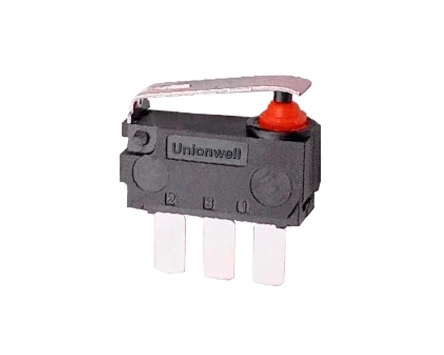
Global_Safety_Approvals_Basic_Micro_Switch_G5.webp "Global Safety Approvals Basic Micro Switch G5")




RM1311, Renfeng Building, No. 490, Tianhe Road, Tianhe District, Guangzhou, Guangdong, China, 510630.
Factory Address:No. 9 Park Avenue, Longmen County, Huizhou City, Guangdong Province, China

As vehicles evolve toward smarter, more connected, and increasingly electrified designs, the demand for precise sensing and reliable feedback mechanisms becomes ever more critical. Among the many small yet indispensable components ensuring vehicle safety and functionality, the micro switch stands out as a key player—particularly when used as a detection switch in fuel filler and charging ports.
Although compact and often unnoticed, micro switches perform a vital function: detecting position changes and converting them into electrical signals that control the vehicle’s systems. Whether it’s a traditional fuel-powered car or a new energy electric vehicle (EV), the accurate detection of port status—open or closed—is essential to prevent fuel spillage, enable safety interlocks, and ensure proper system operation.
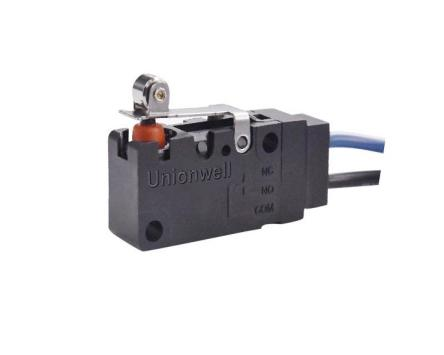
This article explores how microswitches contribute to the safe and intelligent operation of automotive filler and charging ports, and how Unionwell’s G303 series micro switch provides a dependable solution engineered for the demanding automotive environment.
In conventional fuel-powered vehicles, the fuel filler cap must be monitored to ensure it’s properly closed after refueling. A loose or open cap can lead to fuel evaporation, emissions leaks, and even trigger a Check Engine warning due to pressure loss in the evaporative emission system. Similarly, in electric vehicles, charging port covers and charging connectors need accurate position detection to ensure that charging begins and ends safely, and to prevent driving while the charger is still connected.
To achieve this, automakers integrate detection switches—small but high-precision components that sense mechanical movement and send corresponding electrical signals to the vehicle’s control unit. These signals inform the system about the real-time state of the port:
Fuel filler ports: detect cap open/close status to manage vapor recovery and emission control.
Charging ports: detect door open/close or plug insertion/removal to control charging start, stop, and safety interlock functions.
Without reliable detection, both systems would face safety, performance, and compliance risks.
A micro switch—also known as a snap-action switch—is characterized by its small contact gap, rapid switching mechanism, and highly repeatable actuation. It is designed to respond instantly to small movements with a precise on/off electrical signal.
Key advantages of using micro switches in these automotive detection scenarios include:
High Precision and Repeatability:
Micro switches are engineered for exact actuation points, ensuring consistent performance even after hundreds of thousands of cycles.
Mechanical Robustness:
Their durable construction allows them to withstand vibration, temperature fluctuations, and mechanical shocks common in vehicle environments.
Compact Size:
Space is always limited in vehicle assemblies. Micro switches offer high functionality within a small footprint, allowing integration into tight mechanical structures.
Fast Response:
The “snap action” mechanism provides a crisp transition between on and off states, ensuring immediate feedback to electronic control units.
Versatility:
Available in a variety of levers, terminals, and mounting configurations, micro switches can adapt to different port designs and actuation mechanisms.
These features make micro switches the preferred detection solution for both mechanical fuel filler caps and electric vehicle charging ports, where reliability under harsh conditions is non-negotiable.
In fuel-powered vehicles, the filler cap detection system ensures that the cap is securely closed after refueling. When the cap is tightened, it presses a lever or actuator linked to the micro switch. The switch instantly changes its contact state, sending a signal to the ECU (Engine Control Unit).
If the cap is not fully closed, the signal indicates an open circuit, and the ECU may prevent system pressurization or trigger a dashboard alert. This function helps prevent hydrocarbon emissions, supports emission compliance, and protects the integrity of the fuel system.
The micro switch used in this environment must therefore withstand exposure to fuel vapors, moisture, dust, and vibration—all while maintaining stable operation over the vehicle’s lifetime.
As electric mobility accelerates, charging ports have become a new critical interface between vehicles and external energy sources. A micro switch is typically used in two main detection functions:
Port cover detection: confirms whether the charging door is open or closed, enabling the system to authorize charging only when the port is accessible.
Plug insertion detection: identifies whether the charging connector is properly engaged, allowing charging current to flow safely.
When the connector is inserted, the micro switch detects the mechanical displacement and signals the battery management system (BMS). This ensures charging begins only when the plug is fully seated and stops automatically when removed.
Because charging ports are exposed to outdoor environments, the micro switch must be waterproof, dustproof, and temperature-resistant—capable of enduring everything from summer heat to freezing winter conditions.
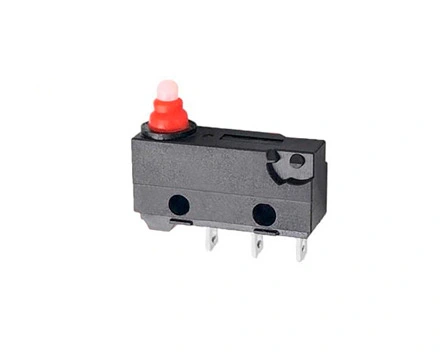
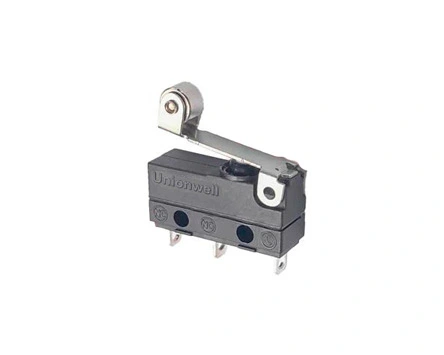
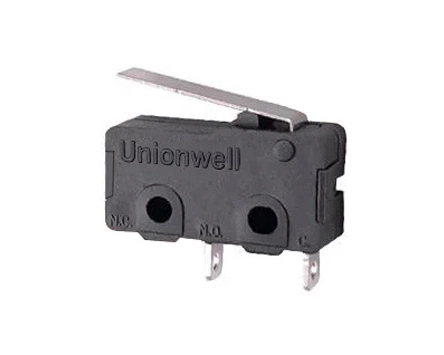
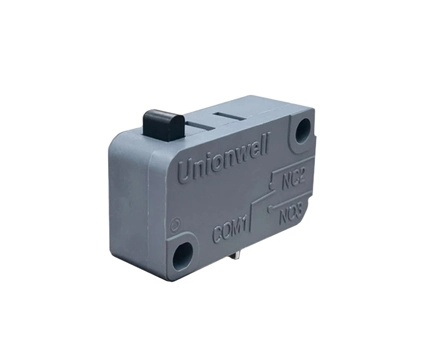
In both fuel and charging port applications, micro switches face the same challenges: exposure to the elements, limited installation space, and the need for absolute reliability. The Unionwell G303 series subminiature micro switch is designed precisely to meet these demands.
Key Features of the Unionwell G303 Series
IP67-rated water and dust protection — ensures reliable operation even under prolonged exposure to moisture, fuel vapor, and dust.
Compact structure — easily fits into narrow port housings without sacrificing electrical performance.
Long mechanical life — up to 500,000 cycles, maintaining consistent actuation force and contact reliability.
Global safety approvals — compliant with major international standards, supporting global automotive platforms.
Wide operating range — functional from -40°C to +85°C, ensuring stable operation in all climates.
Customizable configurations — offers multiple lever types and terminal options for integration flexibility.
| Parameter | Specification |
| Rating | 0.1A, 125/250VAC; 3A/12VDC; 0.1A/48VDC |
| Electrical Life | ≥ 100,000 cycles (depending on model) |
| Mechanical Life | ≥ 500,000 cycles |
| Dielectric Strength | 500VAC (50–60Hz) |
| Vibration Durability | 10–55Hz, 0.75mm amplitude |
| Operating Humidity | ≤ 85% RH |
| Insulation Resistance | ≥ 100MΩ (at 500VDC) |
These specifications make the G303 a trusted choice for vehicle manufacturers and system integrators seeking high-reliability detection solutions in challenging environments.
Beyond its performance characteristics, the Unionwell G303 is designed with automotive system engineers in mind. Each component reflects Unionwell’s focus on sensing accuracy, manufacturing quality, and long-term durability.
Automotive-grade reliability: Tested to endure mechanical vibration, temperature cycling, and environmental sealing required for underhood and exterior applications.
Flexible design options: Available in various actuator and terminal types to match different mechanical interface requirements.
Proven in global markets: The G303 series has been adopted in numerous international automotive projects for its stable and repeatable switching performance.
Comprehensive compliance: Certified to major safety and quality standards, ensuring compatibility with vehicle manufacturing regulations worldwide.
The operation of a fuel filler or charging port might appear trivial—simply opening and closing a cover—but behind that action lies a carefully designed chain of mechanical and electrical components. The micro switch serves as the critical link that translates motion into information, allowing the vehicle to respond intelligently and safely.
As the automotive industry moves toward electrification and digitalization, reliable detection switches like the Unionwell G303 will continue to play a foundational role in connecting human interaction with machine control.
From traditional fuel systems to next-generation electric charging architectures, Unionwell remains dedicated to providing precision-engineered sensing and control solutions that meet the evolving demands of modern mobility.
In every refueling or charging operation, safety, efficiency, and accuracy depend on seamless detection. The micro switch—though small—delivers the precise electrical feedback that makes this possible.
Unionwell’s G303 series micro switch exemplifies the fusion of compact design, robust construction, and high sensitivity needed for today’s automotive applications. With its IP67 protection, global certifications, and proven reliability, it continues to set the benchmark for detection switch performance in fuel filler and charging port systems worldwide.
