As automotive technology evolves toward greater intelligence and electrification, seat systems in passenger vehicles are becoming increasingly sophisticated. From basic mechanical adjustment to electrically powered multi-directional movement, folding mechanisms, and memory functions, seats are no longer just about comfort — they play a vital role in occupant safety and integration with the vehicle's control systems. In particular, detecting and confirming the locked state of seats during movement or folding is a key safety requirement.
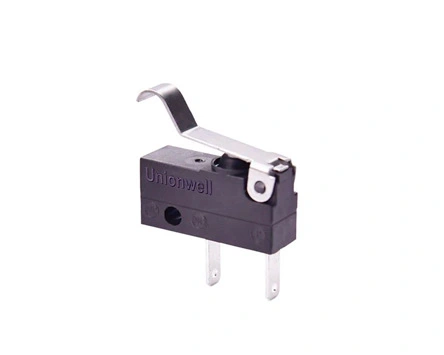
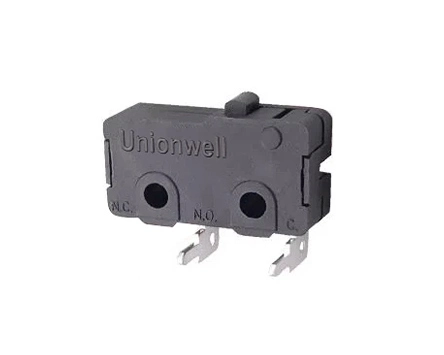
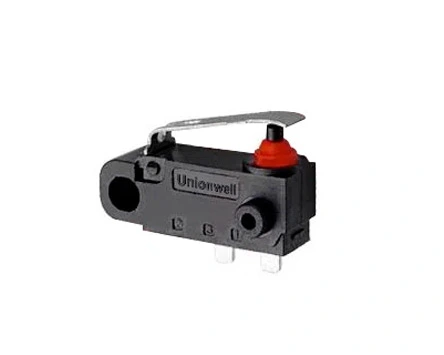
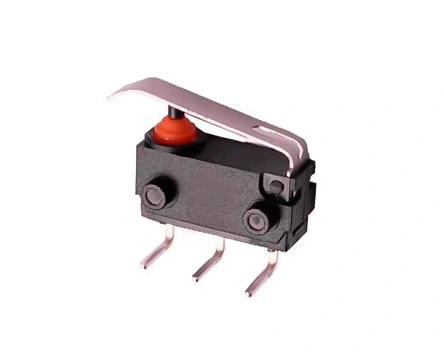
Among various seat-state detection technologies, microswitches have gained widespread adoption in locking mechanisms due to their fast response, compact structure, long life, and cost-efficiency. This article explores the application of microswitches in seat lock systems, highlighting the engineering value and performance advantages of Unionwell's G303R series — a microswitch with an integrated resistor.
Control Logic and Safety Requirements of Seat Lock Systems
Modern seat locking isn't just about mechanical latches — it requires reliable electronic feedback to communicate the lock status to the vehicle's control system. This feedback is essential for:
Confirming seat reset completion before allowing vehicle startup.
Verifying seat position before enabling airbag deployment.
Detecting lock engagement before allowing seat motors or sliding mechanisms to operate.
Providing input signals to systems like the Body Control Module (BCM) and Supplemental Restraint System (SRS).
For example, in foldable second-row seats, if locking isn't confirmed, the system must prevent side airbags from activating. Similarly, if a sliding seat remains unlocked, motor operation must halt to avoid damage.
This creates a demand for a precise, binary, and fast-reacting signal source — a requirement perfectly met by microswitches.
How Microswitches Function Within Seat Structures
1. Functional Characteristics of Microswitches
Microswitches are compact electrical devices that change states with minimal force, triggered by a lever or button mechanism. Their typical design includes:
Contact-based switching: Enables instant actuation and reduces signal bounce.
Spring mechanism: Creates a distinct actuation threshold.
Normally Open (NO)/Normally Closed (NC) terminals: Deliver clear binary signals.
Key performance benefits include:
High-speed actuation with excellent repeatability
Long operational life — often exceeding one million cycles
Compact size for tight-space integration
Reliable performance under harsh conditions — heat, moisture, dust, etc.
2. Typical Installation in Lock Mechanisms
Microswitches are commonly installed at the end of seat tracks or near lock latches. When the seat latch engages, a mechanical arm or contact presses the switch button, sending a signal to the vehicle's ECU.
They are typically used in:
Power seat track reset confirmation
Folded seat position detection (2nd/3rd row)
Child seat anchor lock validation
Front passenger seat flip-forward monitoring
Thanks to their simplicity and reliability, microswitches provide accurate feedback on lock status — a foundation for safe system operation.
Why Choose a Microswitch with a Built-in Resistor?
In conventional designs, switch signals are defined by simple ON/OFF states. However, in the vehicle's electrically noisy environment, interference can lead to unstable signals or even short circuits. A microswitch with an internal resistor helps mitigate these risks.
Key Advantages:
Improved EMI resistance: The internal resistor helps define signal levels, reducing false triggering.
Simplified circuit design: Eliminates the need for external current-limiting or voltage-divider components.
Enhanced fault tolerance: Limits current flow even in the event of a short, reducing system risk.
Design standardization: Compatible with digital networks such as CAN or LIN, easing system integration.
Unionwell G303R: Purpose-Built for Seat Lock Systems
To meet the automotive industry's growing demand for compact, reliable, and interference-resistant components, Unionwell developed the G303R microswitch series — optimized specifically for seat lock detection.
G303R Key Technical Highlights:
Feature
Description
Built-in Precision Resistor
Stable signal output that reduces false triggering
Contact-based Switching
Fast, crisp switching response for accurate state detection
High-Temp, Corrosion-Resistant Housing
Withstands dust, humidity, and thermal stress under the seat
Variety of Actuators & Terminals
Offers multiple actuator styles and terminal types for easy integration
Custom Configuration Options
Available in different operating forces, terminals, and package designs
The G303R has been successfully validated in multiple seat rail and locking module designs, and Unionwell also provides support for EMC testing and electrical calibration.
Feedback Mechanism: Structure & Signal Flow
In a typical seat track locking system, the G303R is positioned at the end of the track. When the seat returns to its locked position, a moving cam or latch arm presses the switch button. The G303R then changes its state (e.g., from NC to NO), and the internal resistor ensures a clean, stable signal level. The ECU interprets this as a confirmed lock, enabling subsequent actions such as motor drive or airbag readiness.
This “mechanical action + electrical feedback” approach is a widely adopted safety strategy in today's passenger vehicles.
Final Thoughts: Reliable Signals, Reliable Systems
In the intricate design of automotive seating, small components can make a big difference. Microswitches — though simple — play a decisive role in ensuring that safety-critical systems function correctly.
At Unionwell, we believe a high-quality microswitch should be more than just a basic ON/OFF device. It must serve as a reliable node in the broader system architecture, capable of delivering consistent performance under all conditions.
The G303R series was built with this philosophy in mind. We look forward to seeing it implemented in more vehicle platforms — acting as a dependable bridge between mechanical motion and electronic decision-making.
Factory Address:No. 9 Park Avenue, Longmen County, Huizhou City, Guangdong Province, China
+86-13431874643
We use cookies to offer you a better browsing experience, analyze site traffic and personalize content. By using this site, you agree to our use of cookies.
Visit our cookie policy to learn more.
 English
  français
  Deutsch
  Español
  italiano
  português
  tiếng việt
  Türkçe
  slovenský
  slovenčina
  беларускі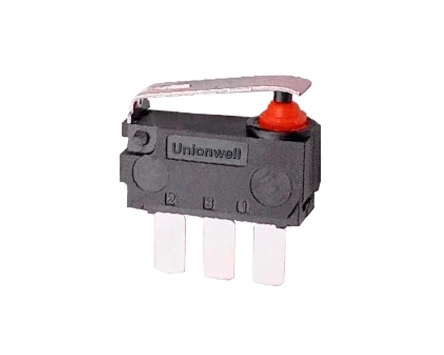
Global_Safety_Approvals_Basic_Micro_Switch_G5.webp "Global Safety Approvals Basic Micro Switch G5")