 English
  français
  Deutsch
  Español
  italiano
  português
  tiếng việt
  Türkçe
  slovenský
  slovenčina
  беларускі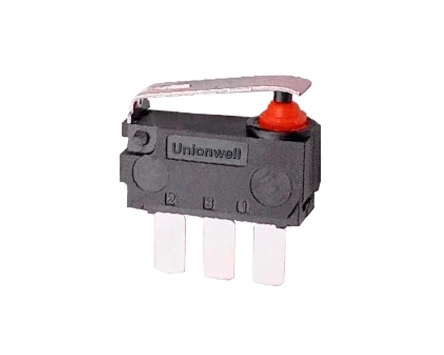
Global_Safety_Approvals_Basic_Micro_Switch_G5.webp "Global Safety Approvals Basic Micro Switch G5")


RM1311, Renfeng Building, No. 490, Tianhe Road, Tianhe District, Guangzhou, Guangdong, China, 510630.
Factory Address:No. 9 Park Avenue, Longmen County, Huizhou City, Guangdong Province, China

Micro switches are critical components used in automotive electronics, smart appliances, industrial automation, and IoT devices. But when it comes to selecting the perfect configuration, one question always arises: SPST vs. SPDT vs. DPST vs. DPDT micro switch — which one is right for your application?
In this guide, we break down each type with clear diagrams, side-by-side comparisons, wiring tips, industry applications, and a step-by-step selection checklist.
A micro switch (also called a snap-action switch) is a precision electromechanical device that opens or closes an electrical circuit with a very small actuator movement and minimal force. Its hallmark is the "snap" action that ensures fast, reliable switching even under vibration or shock.
The four most common configurations—SPST, SPDT, DPST, and DPDT—refer to the number of poles (independent circuits) and throws (output positions). Getting this wrong can lead to:
Unexpected circuit failures
Safety issues in automotive or medical devices
Higher costs from over-engineering
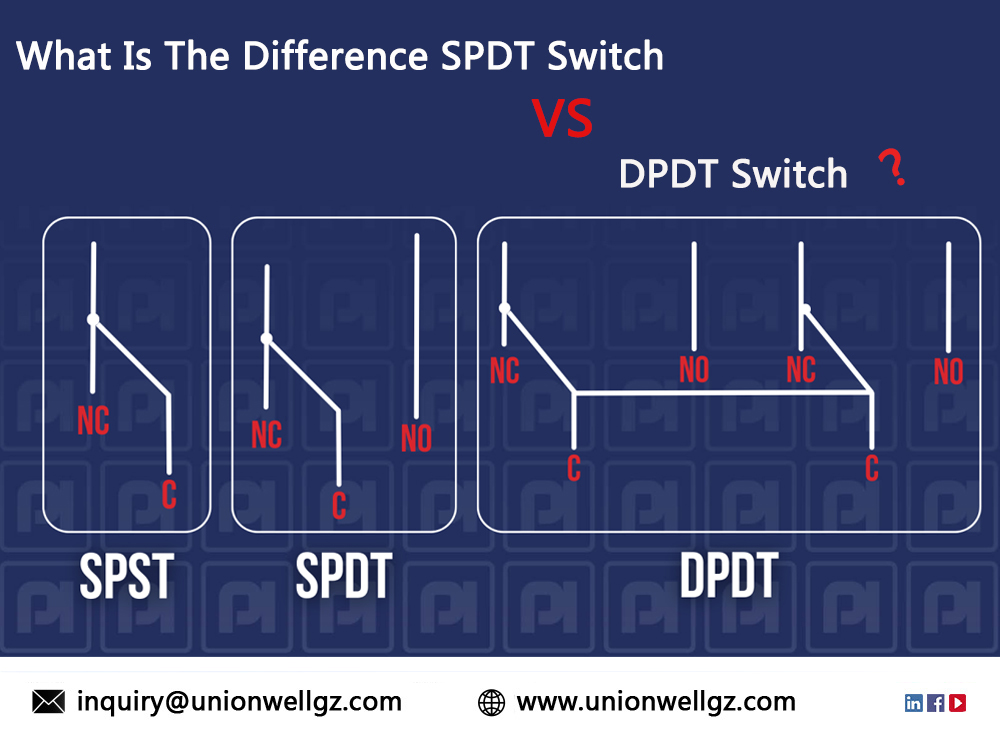
Before comparing switch types, we must first understand two key electrical terms:
Pole
The pole indicates how many independent circuits a switch controls.
Example:
Single Pole (SP) → controls one circuit
Double Pole (DP) → controls two circuits
Throw
The throw indicates how many output paths a switch can connect to.
Example:
Single Throw (ST) → one output path
Double Throw (DT) → two output paths
So the switch naming format becomes:
Switch Type | Meaning |
SPST | Single Pole Single Throw |
SPDT | Single Pole Double Throw |
DPST | Double Pole Single Throw |
DPDT | Double Pole Double Throw |
The following table compares SPST, SPDT, DPST, and DPDT micro switches in terms of circuit configuration, function, cost, and typical applications.
Feature | SPST Micro Switch | SPDT Micro Switch | DPST Micro Switch | DPDT Micro Switch |
Poles | 1 | 1 | 2 | 2 |
Throws | 1 | 2 | 1 | 2 |
Terminals | 2 | 3 | 4 | 6 |
Function | Simple ON/OFF control | Changeover between two circuits | Simultaneous ON/OFF of two circuits | Changeover control of two circuits |
Best For | Basic power control | Signal routing/selector | Dual circuit switching | Motor direction / complex logic |
Typical Size | Small | Small | Medium | Medium–Large |
Cost Level | Lowest | Low | Medium | Higher |
Unionwell Example | G5 series | G303 / G304 waterproof | G606 DPST config | G606 / G21 DPDT |
Typical Mechanical Life | 100K–1M cycles | 500K–5M cycles | 300K–1M cycles | 300K–2M cycles |
Definition & How It Works
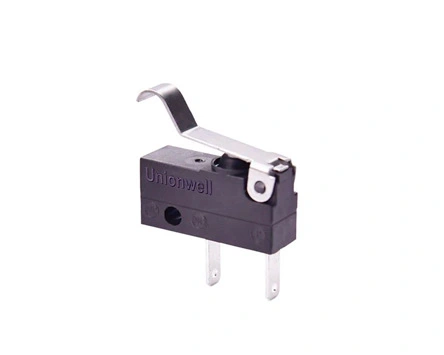
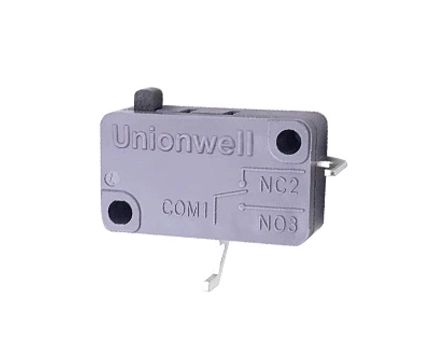
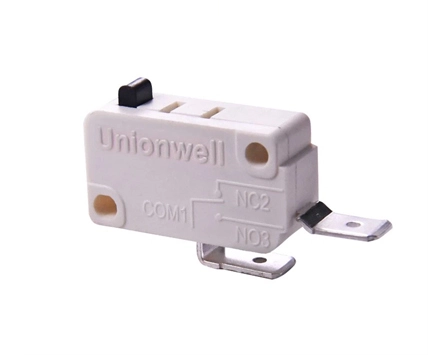
The SPST micro switch is the simplest and most common on/off switch. It has two terminals (Common + Normally Open or Normally Closed). When actuated, it either completes or breaks a single circuit.
Typical Terminals: C (Common) + NO or NC
Function: Basic ON/OFF control.
Pros:
Lowest cost
Simplest wiring
Highest reliability for single-circuit applications
Compact size (perfect for space-constrained designs)
Cons:
No switching between circuits
Limited to one function
Applications:
Power buttons on coffee machines
Door-open detection in refrigerators
Safety interlocks in electric tools
Unionwell’s G5 series basic micro switches (widely used in dishwashers and toasters)
Definition & How It Works
An SPDT micro switch has three terminals: Common (C), Normally Open (NO), and Normally Closed (NC). The actuator routes the common terminal to either NO or NC — perfect for change-over applications.
Typical Terminals: C + NO + NC
Function: Switches between two output paths.
Pros:
Excellent flexibility
Can act as both normally-open and normally-closed
Widely available in waterproof IP67 versions
Long electrical life (often 100,000–1,000,000 cycles)
Cons:
Slightly more complex wiring than SPST
Popular Applications:
Reversing motor direction (e.g., car window regulators)
HVAC mode selection (heating/cooling)
Automotive seat adjustment and door latches
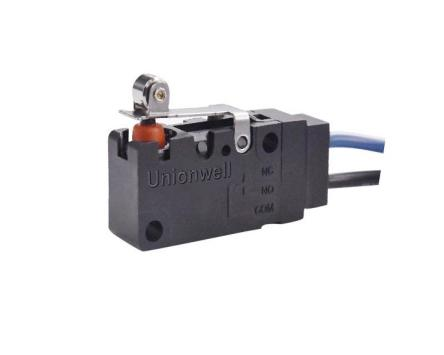
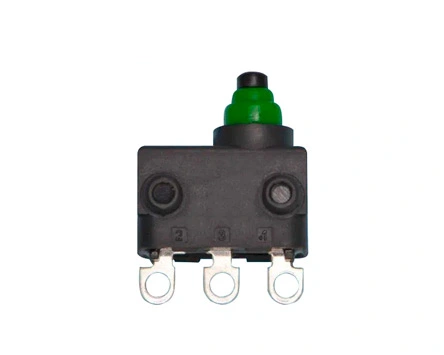
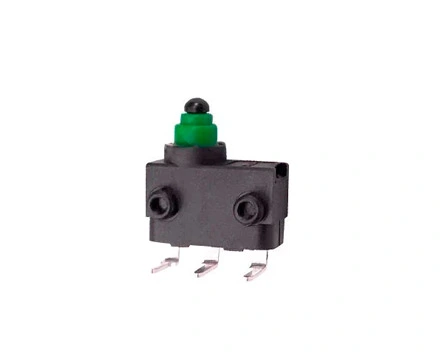
Unionwell G303 & G304 waterproof SPDT micro switches — IP67 sealed for EV charging guns and automotive electronics
If you’re searching for a reliable SPDT micro switch, Unionwell’s subminiature G303 series is one of the most trusted options globally.
Definition & How It Works
A DPST micro switch controls two independent circuits with a single actuator. It has four terminals (two Commons + two NO or NC). Both circuits turn ON or OFF together — like two SPST switches in one housing.
Typical Terminals: 2×C + 2×NO (or NC)
Function: Simultaneous on/off of two circuits (great for safety isolation).
Pros:
Controls two circuits at once
Provides galvanic isolation
Safer for AC/DC dual-voltage systems
Cons:
Larger footprint than single-pole versions
Higher cost than SPST
Applications:
Dual-voltage power supplies
Industrial motor starters
Safety shut-off in power tools
Unionwell G606 series offers DPST configurations for heavy-duty use
Definition & How It Works
The most advanced — a DPDT micro switch has six terminals (2×C + 2×NO + 2×NC). It’s essentially two SPDT switches operating in sync, allowing you to reverse polarity or switch two circuits between two paths each.
Typical Terminals: 2×C + 2×NO + 2×NC
Function: Complex routing or motor reversal.
Pros:
Maximum flexibility
Ideal for direction control
Can simulate change-over for stereo audio or dual signals
Cons:
Most complex wiring
Larger size and higher cost
Applications:
Forward/reverse motor control (car windows, power seats)
Polarity reversal in battery systems
Signal routing in test equipment
Unionwell G606, G21, and G11 DPDT micro switches — sealed versions for automotive and industrial use
In simple terms, SPST switches provide basic ON/OFF control, SPDT switches allow changeover between two circuits, while DPST and DPDT switches control two circuits simultaneously with different switching capabilities.
How many circuits do you need to control? 1 = SPST or SPDT; 2 = DPST or DPDT.
Do you need to switch between two outputs? Choose SPDT or DPDT.
Voltage & current requirements? (Unionwell offers up to 250VAC/16A)
Environmental protection? IP67 waterproof versions for automotive/EV (G303/G306 series).
Actuation force & travel? (We provide 2D/3D drawings and free samples.)
Certifications needed? UL, cUL, ENEC, CE, CB, CQC — all standards at Unionwell.
Pro tip from our R&D team (20–30+ years experience): Always test with free samples in your actual environment. Over 90% of our production is fully automated, ensuring consistent quality.
Unionwell is a professional micro switch manufacturer located in Guangdong, China, with products widely used across industries including automotive electronics, IoT devices, smart home appliances, and Industry 4.0 systems.
Key advantages include:
ISO9001, IATF16949, ISO14001 certified production
100% final inspection before shipment
automated production and testing systems
waterproof and dustproof micro switches
experienced R&D team with 20+ years of expertise
With strong engineering capabilities and global certifications, Unionwell provides reliable switching solutions for demanding applications.
What is the difference between SPST and SPDT micro switches?
An SPST micro switch simply turns one circuit ON or OFF, while an SPDT micro switch can switch the circuit between two different outputs. When should I use a DPDT micro switch?
A dpdt micro switch is ideal when you need to control two circuits and switch between two paths, such as motor direction control.
Are micro switches reliable?
Yes. High-quality micro switches can reach millions of switching cycles, making them suitable for industrial and automotive applications.
Can a DPST micro switch replace two SPST switches? Yes — and it saves space and wiring.
Which type is best for automotive applications? Sealed SPDT or DPST with IATF16949 certification.