 English
  français
  Deutsch
  Español
  italiano
  português
  tiếng việt
  Türkçe
  slovenský
  slovenčina
  беларускі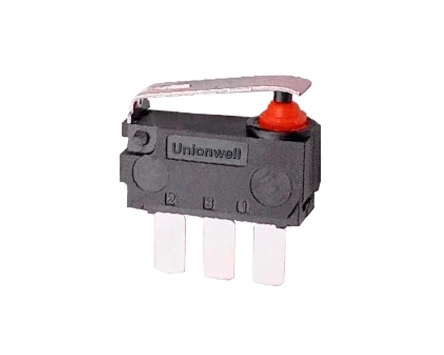
Global_Safety_Approvals_Basic_Micro_Switch_G5.webp "Global Safety Approvals Basic Micro Switch G5")


RM1311, Renfeng Building, No. 490, Tianhe Road, Tianhe District, Guangzhou, Guangdong, China, 510630.
Factory Address:No. 9 Park Avenue, Longmen County, Huizhou City, Guangdong Province, China

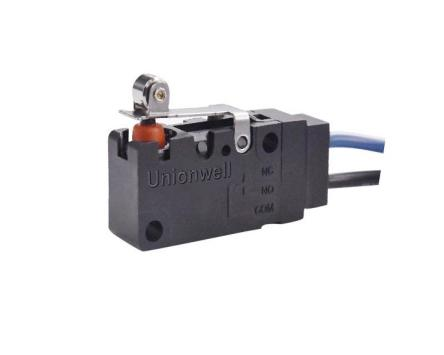
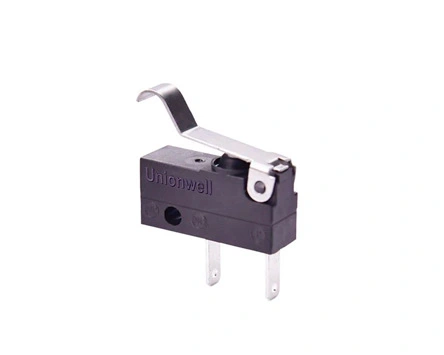
A single-pole double-throw (SPDT) micro switch is a precision switching device with one common terminal (COM) and two output terminals (NO/NC), enabling rapid switching between two circuits. It is an important circuit component in modern electronic devices. This article will provide a detailed introduction to what an SPDT micro switch is.
SPDT micro switch refers to a micro switch with a single-input, double-output circuit structure. SPDT stands for Single Pole Double Throw:
"Single pole" refers to a single common input (COM);
"Double throw" means that this input can switch between two outputs: normally closed (NC) and normally open (NO).
When the switch is in the untriggered state, COM is normally connected to NC; when an external force triggers the switch, the internal mechanism activates, and COM quickly switches to NO, thus changing the circuit path.
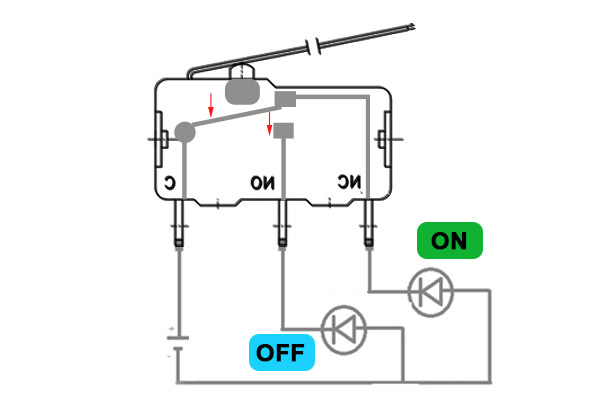
Compared to SPST micro switches (single-pole single-throw micro switches) and DPST micro switches (double-pole single-throw micro switches), the biggest advantage of SPDT micro switches lies in their dual-loop switching capability. This structure allows them to not only achieve "on/off" control, but also "path selection" or "state switching," thus making them more valuable in complex logic control systems.
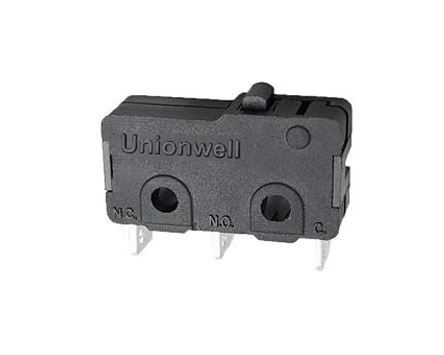
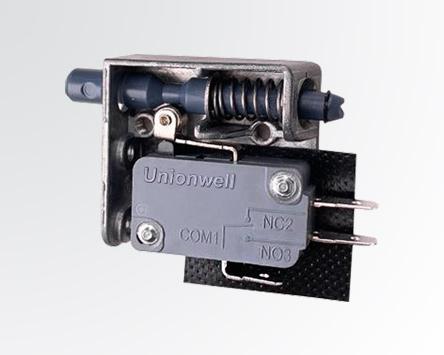
Inside the SPDT micro switch, the most critical component is the three-terminal contact structure, including the common terminal COM, the normally open terminal NO, and the normally closed terminal NC. COM is the core signal input, switching between NO and NC via mechanical action.
By default, COM and NC remain conductive, forming a stable circuit. When an external force is applied to the drive terminal, the internal spring deforms, triggering a switching action that quickly switches COM to NO. This structure ensures the clarity and stability of the circuit state, preventing signal drift or intermediate uncertainties.
In terms of mechanical structure, an SPDT micro switch typically consists of:
driver
metal spring
contact
housing
The driver receives external mechanical force, such as button or handle presses; the spring system is the core power component, achieving rapid action through elastic deformation; and the contacts are responsible for completing electrical connections. The key to this structural design is "instantaneous switching," that is, completing the contact state transition in a very short time, thereby reducing arcing and increasing service life.
In terms of terminal layout, SPDT micro switches typically employ a three-terminal design: COM, NO, and NC. This layout allows for flexible application in various circuit designs, such as selective on/off, dual-path control, or signal switching. In practical applications, engineers can select different terminals to connect based on system requirements, thereby achieving different logic control methods and improving design flexibility.
The working principle of the SPDT micro switch is based on the conversion relationship between mechanical force triggering and circuit switching, and its core is the snap action mechanism.
In the untriggered state, the internal COM and NC of the SPDT micro switch remain connected, forming the default circuit path. When external mechanical force is applied to the drive structure, the internal mechanism shifts, causing the COM to switch from NC to NO, thus changing the circuit path. This switching has a clear logical state, and therefore can be used as a signal judgment basis in the control system ("present/absent", "on/off", or "in position/not in position"), allowing the device to understand its correct state at this time.
Snap action is one of the core technologies of SPDT micro switches. When an external force is gradually applied to the spring structure, the spring deforms instantaneously and flips rapidly after reaching a critical point, thus completing the contact switching. This instantaneous action avoids the contacts remaining in an intermediate state, thereby reducing contact resistance instability, reducing arc loss, and improving overall reliability.
During signal transmission, the SPDT micro switch achieves rapid conversion from mechanical to electrical signals. When COM switches from NC to NO, the circuit state changes immediately, and the control system can quickly identify the state change. This clear signal conversion mechanism makes the SPDT micro switch suitable for applications requiring high response speed.
Dual Circuit Switching: Supports switching between two circuit paths from a single common terminal, enhancing circuit design flexibility.
Fast Response (Snap Action Mechanism): Employs a fast-action structure for instantaneous contact switching, ensuring accurate and stable signals.
Compact Structure: Compact size, easy to integrate into space-constrained devices.
High Reliability: Long contact lifespan and stable repetitive action, suitable for high-frequency applications.
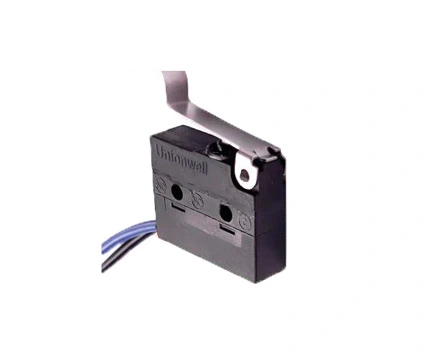
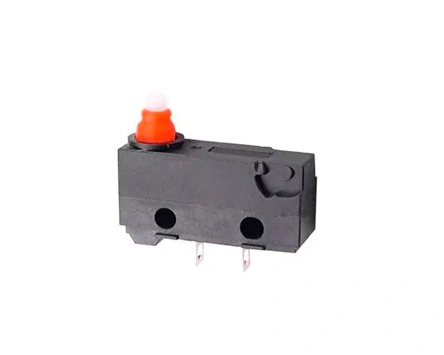
Environmental Adaptability: Some models are waterproof and dustproof, enabling stable operation in complex environments.
Versatile Application Compatibility: Suitable for various applications including home appliances, automotive electronics, and industrial control.
In the home appliance industry, SPDT micro switches are commonly used in appliances such as juicers, coffee makers, and microwave ovens, primarily for safety detection, lid recognition, and function control. For example, the device is only allowed to start when the lid is closed, thereby improving safety.
In automotive electronic systems, SPDT micro switches are used for door detection, seat position detection, and function switching control, providing reliable status feedback signals for the vehicle.
In industrial automation equipment, SPDT micro switches are commonly used for limit detection, machine position recognition, and signal feedback control, and are one of the essential basic components of automation systems.
In conclusion, SPDT micro switches, as micro switches with dual-circuit switching capabilities, play an irreplaceable and crucial role in modern electronic control systems. Their compact structure, fast response, and flexible control make them widely used in home appliances, automobiles, and industrial equipment.
For manufacturers and equipment design engineers, choosing high-quality SPDT micro switches designed by micro switch manufacturers not only improves system stability and security but also optimizes overall circuit design, enhancing product competitiveness and lifespan.